
Our photorealistic Digital Signers for German Sign Language (DGS) are set to launch at the end of 2026.
At IBC in Amsterdam, together with our partner Signapse, we showed how Digital Signers are built and how they fit into a live workflow. The talk by Will Berry (Signapse) and Alexander Leschinsky (G&L) is now available to watch.
Sign Language for Streaming and Media Libraries: A Problem of Scale
Around 200,000 people in Germany use German Sign Language (DGS), and about 80,000 of them are Deaf. But there are far too few qualified DGS interpreters to go round.
Then there is the legal side. The European Accessibility Act (EAA) has applied since 28 June 2025, and Germany has transposed it into national law as the Barrierefreiheitsstärkungsgesetz (BFSG). Public-sector providers are also setting themselves targets for more sign language in their content.
Our answer is to generate sign language the way subtitles are made: as a live rendition of the video, sentence by sentence, directly inside your own streaming workflow. That puts sign language within reach of media libraries, archives and large live events too.
From Real Signing to Digital Signer: How the AI Learns
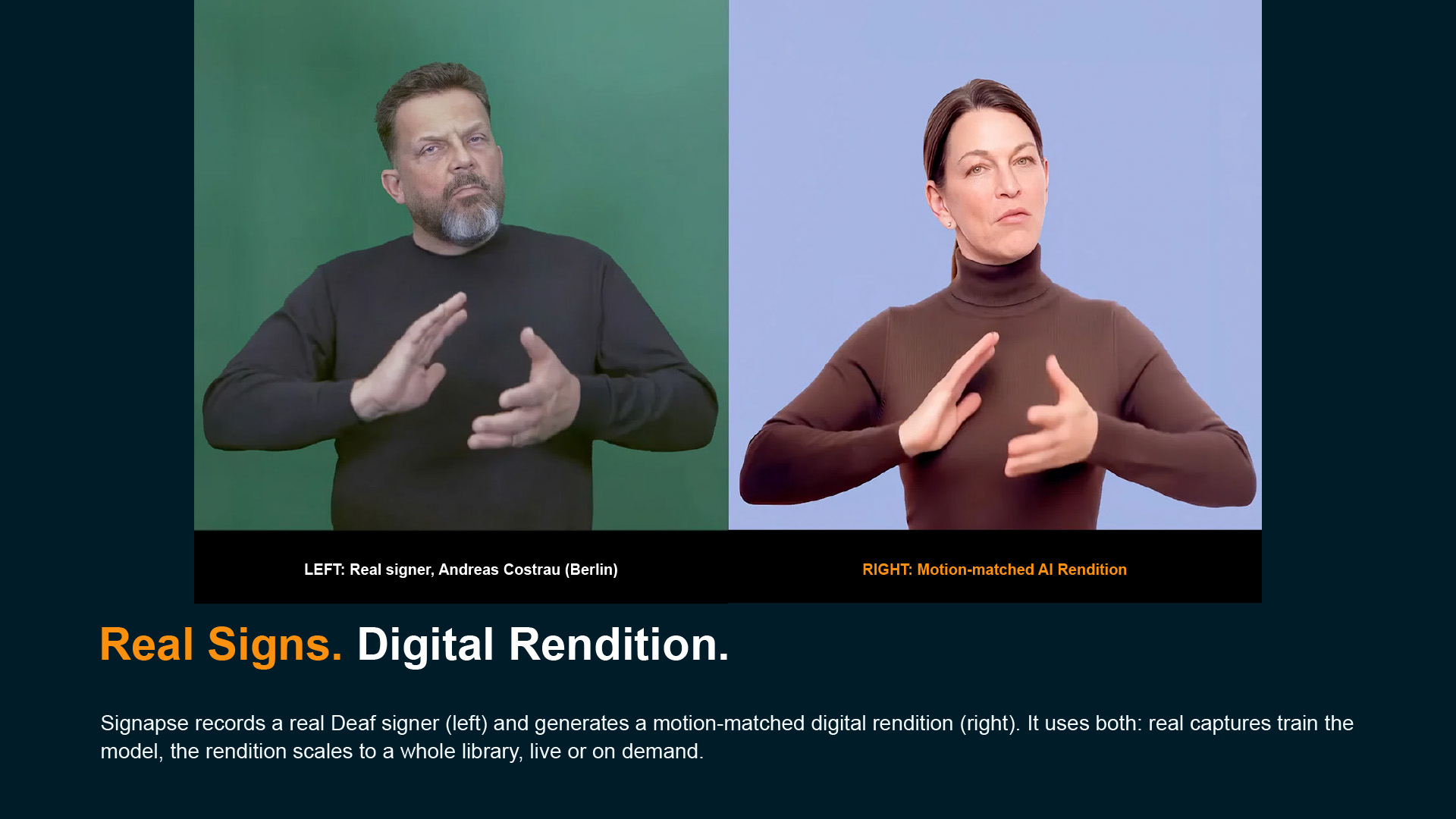
Signapse, a UK-based company that spun out of the University of Surrey, already delivers British and American Sign Language for live and on-demand workflows. The German model is in development, with G&L sponsoring the project.
That is where Andreas Costrau comes in. An experienced DGS coach and lecturer, he signs on camera in a Berlin studio, and a digital version is then matched to his movements.
How a Digital Signer Is Built in Three Steps
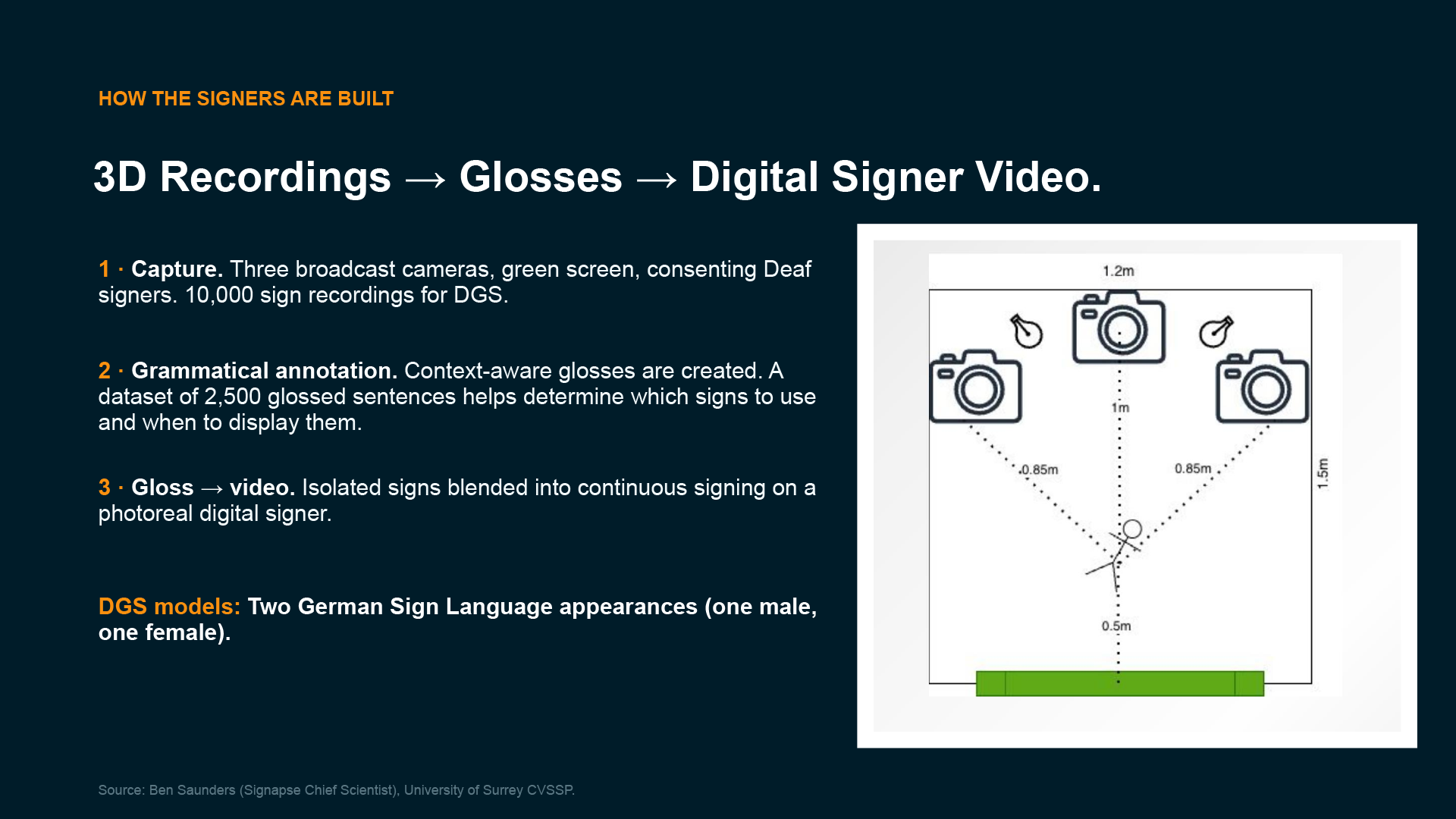
- Capture: Three broadcast cameras record Deaf native signers of German Sign Language in 3D. It takes at least 10,000 individual sign recordings before the data can be used to generate new signs.
- Grammatical annotation: Next, glosses are created. These are written labels for signs, and they carry the context that decides which sign fits. Take the word “match”: it could be a football match, a match you strike to light a candle, or a good match between two people. Only the context tells you which sign to use.
- Gloss to video: Generative AI stitches the glosses together into a smooth, easy-to-follow translation, which is then performed by photorealistic Digital Signers.
There will be two German Digital Signers: a male signer who looks like Andreas Costrau, and a female signer called Kim.
How G&L Integrates Digital Signers into Your Live Workflow
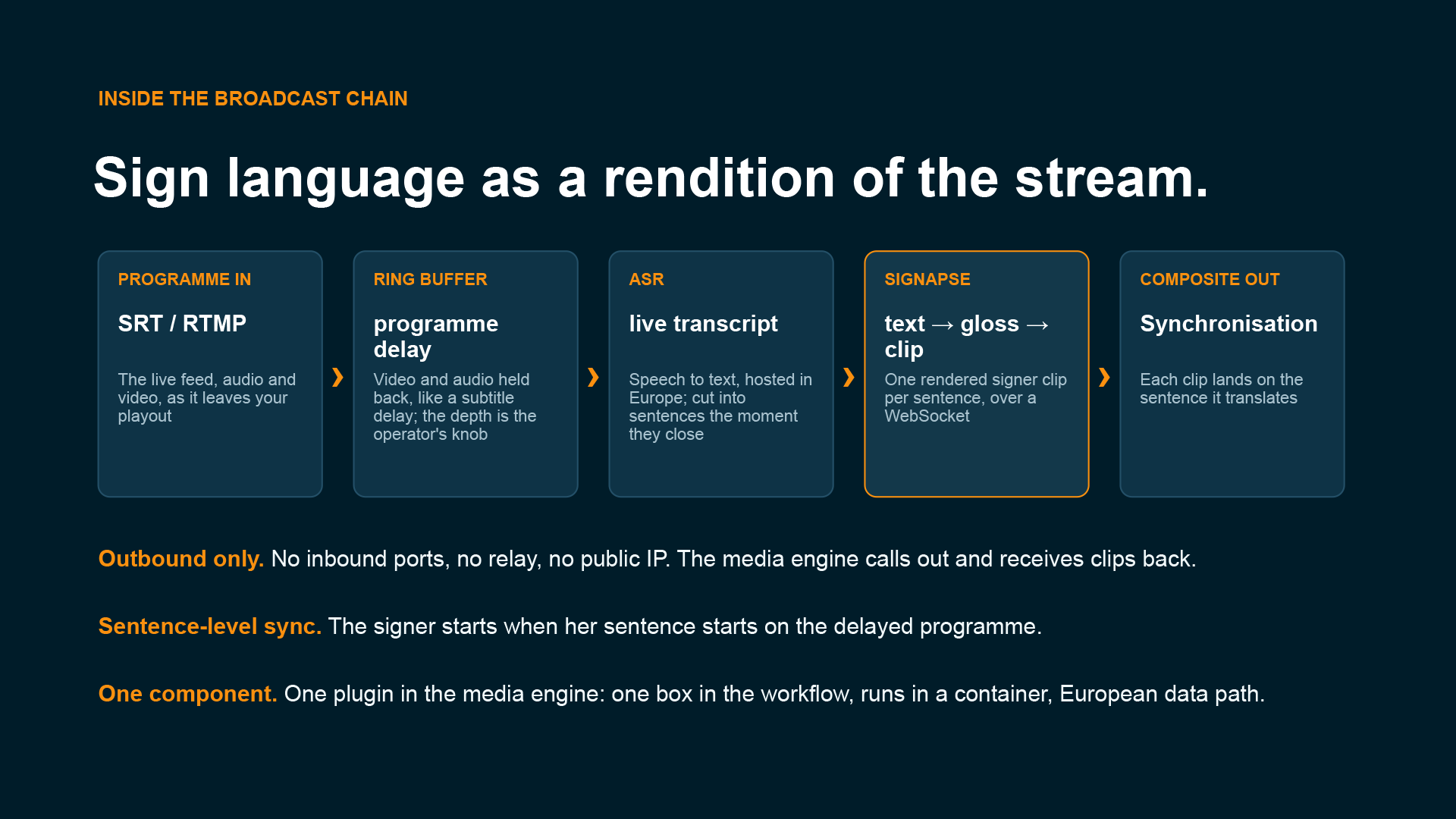
Signapse builds the signing models; our job is to get them working in real-world setups. As a systems integrator, we come from broadcast and streaming, and we know that our customers’ systems vary enormously, with different video and audio formats and protocols. So we build the solution into the environment you already have. In broad terms, a live workflow looks like this:
- Input: SRT/RTMP – your live feed, video and sound, straight from your playout.
- Ring buffer: Delay – video and sound are held back briefly, as with subtitles, and you can choose how long the delay is.
- ASR: Live trascript – speech is turned into text as it is spoken. Speech recognition is hosted in Europe.
- Signapse: Text to gloss to clip – the text is sent to Signapse’s API over WebSockets, and a Digital Signer clip comes back.
- Output: Synchronisation – the Digital Signer is synchronised with your live video and added to it, for example as picture-in-picture.
As for the architecture, the workflow makes outbound connections only, so you need no inbound ports, no relay and no public IP. It is a single plugin that runs in a container inside your workflow, and the data path stays within Europe.
Ready to Take the Next Step?
Get in touch to find out how the Digital Signer could fit into your existing live or on-demand workflows.