
After the UK and the US, a photorealistic digital signer is now coming to Germany
Press release Cologne / Cambridge / Berlin, July 2026
Digital accessibility is increasingly on the agenda, but sign language provision continues to lag far behind. AI can change that. G&L Systemhaus, based in Cologne, and Cambridge-based Signapse are bringing a proven photorealistic sign language technology to Germany. Following successful deployments in the UK and the US, the solution is now being adapted for Deutsche Gebärdensprache (DGS). At the core of this development is a collaboration with Andreas Costrau, an experienced DGS coach, lecturer and published author based in Berlin.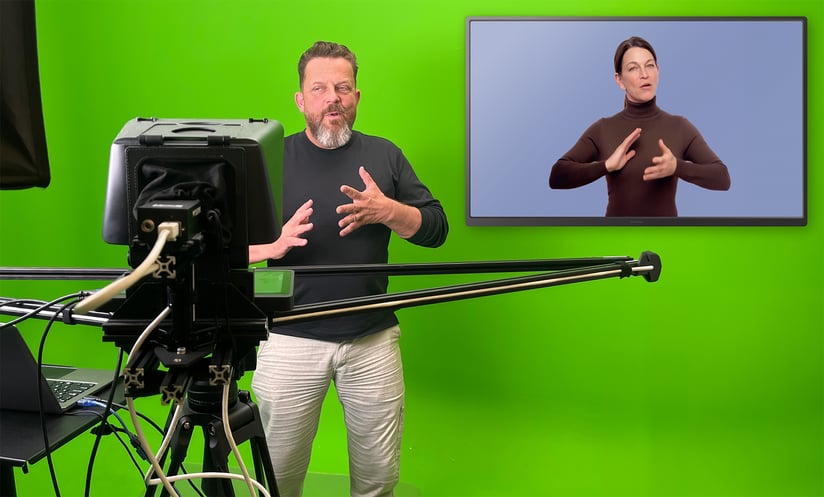
The human behind the AI: Andreas Costrau during studio recordings in Berlin, signing the glosses that bring Digital Signer Kim to life.
The vast majority of digital content is unsigned, not out of indifference
German Sign Language is a complete and independent language. Like any other language, it allows people to communicate, express who they are, access knowledge, and participate fully in society. For many Deaf and hard of hearing people, as well as many other sign language users, DGS is the language through which they engage with the world.
Yet most digital content is still published without it, not because broadcasters or public institutions don't care, but because qualified interpreters are scarce and full coverage has never been realistic at scale.
Subtitles help, but only so far. They demand strong reading literacy and can't capture what a visual language actually does. Around 200,000 people in Germany use DGS as their primary language, and most of what's online simply isn't available to them.
A photorealistic interpreter named Kim
At the heart of the solution is Kim, a photorealistic, AI-powered digital signer ready for German-language content from autumn 2026. Kim is built on the same core technology that Signapse already deploys for British Sign Language (BSL) with National Rail, and for American Sign Language (ASL) with a major US streaming service.
Kim isn't a computer-generated avatar built from scratch. The foundation is extensive video footage recorded with Andreas Costrau, ensuring that signs, facial expressions, and the body language characteristic of DGS are rendered naturally and accurately.
Andreas Costrau: linguistic expertise from within the community
The quality of the DGS model stands or falls on the expertise behind the recordings, which is why Andreas Costrau came on board as language partner. Costrau is a native DGS signer and the third generation of a Deaf family. He is a state-certified DGS trainer widely recognised within the community, a lecturer at the Language Centre of Humboldt University and a staff member at the Catholic University of Applied Social Sciences, both in Berlin. Costrau is also the founder of gebaerdenservice.de, an educational organisation that, alongside translation services, offers coaching and consulting on Deaf culture and language.
Working with a respected and trusted expert was non-negotiable for both G&L and Signapse. Authentic, high-quality signing comes first, and acceptance within the Deaf community depends on a genuine understanding of DGS as an independent language, real respect for its identity, and a deep-rooted connection to Deaf culture.
Recordings are already underway at a green screen studio in Berlin. Costrau signs so-called glosses, the building blocks of sign language, which the Signapse technology then transfers onto Kim with photorealistic precision.
AI is coming, that's a fact, whether we like it or not. That's exactly why I want to help shape where it goes. Working with G&L and Signapse is an opportunity to bring AI-powered sign language to a new linguistic level. German Sign Language cannot be reduced to individual vocabulary items. Facial expressions, head movements, posture, eye gaze, spatial grammar and cultural nuance are just as important as the signs themselves. We're continuously working to capture these subtleties so that the digital solutions we create are authentic and genuinely serve the sign language community, whether people are hearing or Deaf.
From proof of concept to production
The implementation follows a proven approach. G&L integrates the digital signer seamlessly into existing streaming infrastructure, enabling AI-generated DGS to be delivered automatically and at scale, live or on-demand, via API and SDK. Institutions that have previously been unable to provide sign language due to capacity constraints now have a genuinely viable option, both operationally and economically.
What Signapse has built in the UK and the US proves that this technology works, and that it makes a real difference. Now we're bringing that capability to Germany. AI isn't accelerating an existing process here; it's creating an entirely new one, turning a structural problem into something we can actually fix.
A complement, not a replacement
The AI-powered solution is not designed to compete with human professionals. Skilled interpreting remains indispensable wherever live dialogue is involved or where the stakes are high, in medical, legal or politically sensitive contexts, for example. The goal is to fill the gaps where current conditions make full coverage impossible.
About G&L Systemhaus
With roots in the public broadcasting series "Lindenstraße" on ARD, G&L Systemhaus was established in Cologne over 25 years ago by Hans W. Geißendörfer and Alexander Leschinsky, with the aim of bringing television to the internet. Today the company develops streaming solutions for major broadcasters and clients including the Goethe-Institut, Deutsche Telekom, municipalities and state parliaments. Projects include the worldwide live delivery of European Parliament sessions in up to 32 languages, and AI-generated real-time subtitles for local council meetings, including in the state capital Potsdam.
About Signapse
Signapse is a British company based in Cambridge, specialising in AI-powered translation of video and audio content into photorealistic sign language. Founded as a spin-out from the University of Surrey's Centre for Vision, Speech and Signal Processing, Signapse is led by Chief Scientist Dr Ben Saunders, Professor Richard Bowden, and CEO Sally Chalk, who brings over 20 years of experience as Managing Director of one of the UK's leading sign language agencies. The company also has research ties with the University of Oxford and University College London.
The Digital Signer technology was developed in close collaboration with the Royal Association for Deaf People and is already in active use for British Sign Language (BSL) and American Sign Language (ASL). German Sign Language (DGS) is currently in development.
Ready to take the next step?
Get in touch and let's find out how the Digital Signer fits into your live or on-demand setup.